
Can a Decorative Dog Gate Look Like Furniture?
Explore how wood tones, metal patterns, visual openness and proportion transform a decorative dog gate into a coordinated part of the home interior.

Can a Decorative Dog Gate Look Like Furniture?
Pet products are often designed to solve one problem—and visually create another.
A barrier may control access effectively, yet its bright plastic surfaces, industrial tubing or bulky hardware can conflict with the room around it. The product performs its task, but the interior begins to feel temporary.
A decorative dog gate approaches the category differently.
It does not attempt to disappear. Instead, it uses furniture-inspired materials, balanced proportions and ornamental metalwork to become a deliberate part of the room.
The illustrated three-panel design combines warm wooden frames with black metal bars. This contrast gives the gate a clear architectural presence while preserving visual openness between adjoining spaces.
A pet gate can be functional without making the home look unfinished.
The Design Thesis: Pet Products Belong in the Room
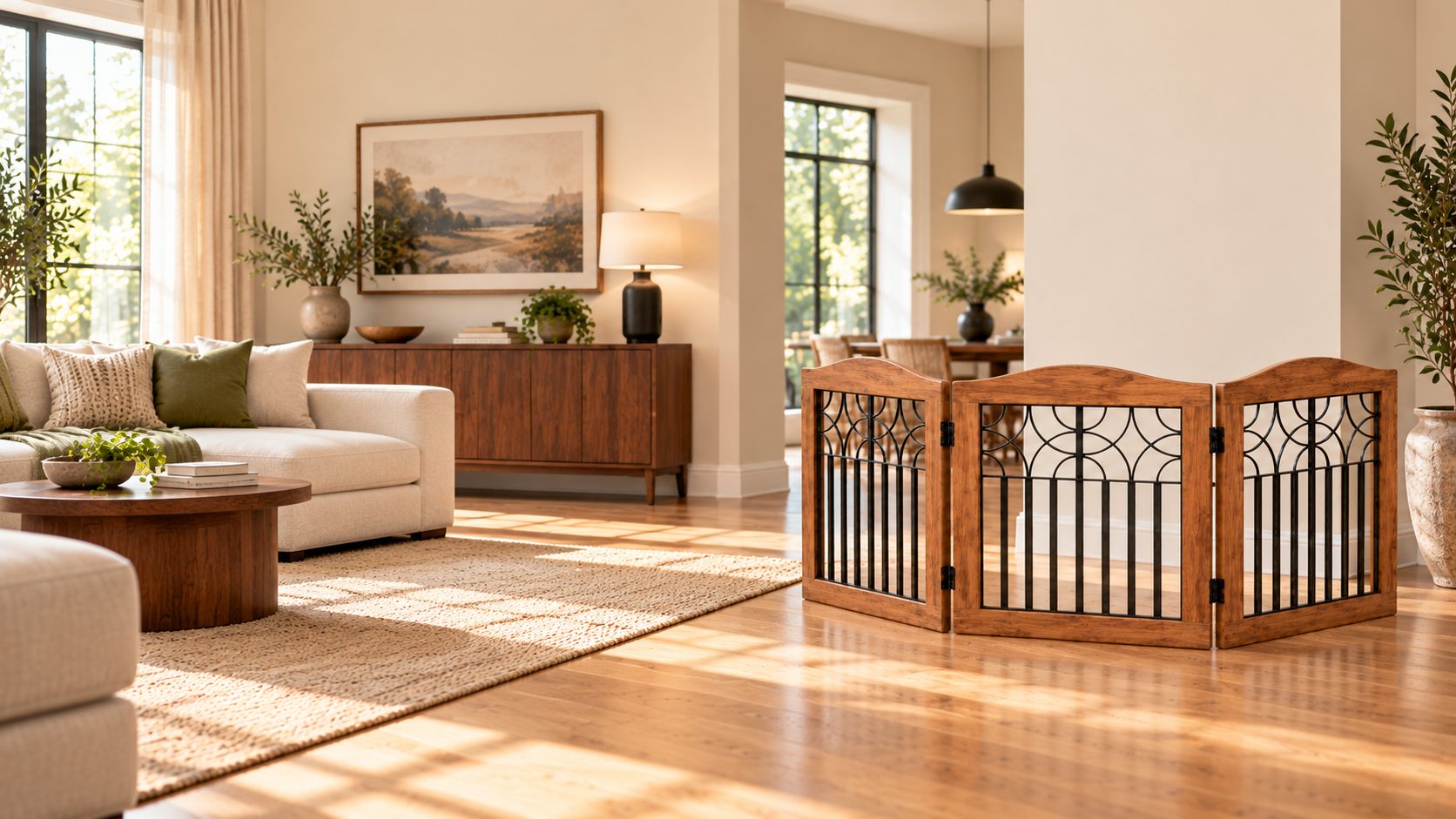
Pet owners do not experience a gate as an isolated product photograph.
They see it beside flooring, cabinets, tables, doors and upholstered furniture. Its color, height, materials and silhouette become part of the interior composition.
This changes the design question.
Instead of asking only:
“Will the gate block the opening?”
Brands should also ask:
Does it coordinate with common furniture finishes?
Does the structure feel visually heavy?
Are the materials appropriate for an indoor product?
Does the pattern suit contemporary and traditional interiors?
Can the gate remain visible without looking temporary?
Does its folded form still appear refined?
These questions create opportunities for differentiation beyond basic dimensions.
A Dialogue Between Wood and Metal
Wood and metal communicate different visual qualities.
Wood introduces warmth, grain and natural variation. Black metal provides contrast, structure and visual precision.
Used together, they create a product that can connect several elements already present in a home:
Wooden flooring
Black cabinet hardware
Metal lighting fixtures
Timber furniture
Dark window frames
Decorative room dividers
Warm neutral interiors
The success of the combination depends on balance.
If the wooden frame is too heavy, the product may appear bulky. If the metal pattern is too dense, it can reduce visual openness. If the frame is too thin, the gate may look less substantial.
The final design should balance appearance, manufacturing feasibility and structural requirements.
Why the Wood Tone Matters
“Brown” is not a complete finish specification.
Wood finishes can appear golden, reddish, gray, dark walnut or nearly natural. Each tone interacts differently with flooring and furniture.
Natural and Honey Tones
These finishes may coordinate with casual, Scandinavian-inspired or bright contemporary rooms.
Medium Walnut Tones
A medium brown finish creates stronger contrast while remaining adaptable across many residential interiors.
Dark Espresso Tones
Darker finishes may suit formal rooms but can make a multi-panel product appear visually heavier.
Painted Finishes
Black, white or muted colors may help brands create modern collections, although paint can conceal natural grain.
Buyers should approve physical color samples because screen images do not reliably represent the final wood finish.
The Metal Pattern Creates Identity
The interior metalwork is not only a containment structure. It is also the product’s most recognizable design feature.
The illustrated gate uses straight vertical rods below and repeated curved forms above. This combination creates a visual transition from structure to decoration.
The lower section appears orderly and stable. The upper curves introduce softness and movement.
A custom metal pattern can help a private-label brand develop a distinctive product language through:
Geometric arches
Repeated circles
Minimal vertical lines
Botanical motifs
Art Deco-inspired curves
Laser-cut metal panels
Brand-specific symbols
Every decorative opening must still be reviewed for spacing, entrapment risks, sharp edges and manufacturing consistency.
Visual Openness Changes the Room
A solid barrier divides a room visually as well as physically.
An open-bar design maintains sightlines between spaces. Light can pass through the gate, and the room may continue to feel connected even when access is limited.
This openness is particularly valuable in smaller interiors where solid panels could create visual weight.
The amount of openness depends on:
Bar spacing
Frame width
Decorative-pattern density
Gate height
Wood color
Metal color
Viewing angle
A visually open gate can still look substantial when its frame and pattern are proportioned carefully.
The Curved Top Creates a Furniture Silhouette
The upper edge of each panel uses a gentle curve rather than a straight horizontal line.
This detail changes the character of the entire product.
A completely straight top may appear more architectural or industrial. A curved profile creates a softer silhouette similar to decorative screens, headboards or traditional furniture panels.
The curve should be evaluated across the complete three-panel configuration. When the panels are positioned at different angles, their upper profiles should still feel visually connected.
Manufacturing consistency is important because small variations in the curves may become noticeable when adjacent panels are compared.
Repetition Creates Harmony
Good decorative design often relies on controlled repetition.
This gate repeats several elements:
Three wooden panel frames
Black metal inserts
Vertical lower bars
Curved upper patterns
Arched wooden tops
Dark hinge hardware
The repetition allows the panels to read as one coordinated object rather than three unrelated pieces.
For product development, buyers should confirm that:
Patterns align consistently
Bar spacing remains uniform
Curves are symmetrical
Frame colors match within an approved range
Hinges are installed at equal heights
Panel gaps remain visually balanced
Consistency is especially important for products displayed in retail photography.
Hardware Should Support the Design
Hinges are necessary, but they are also visible.
Their dimensions, color and placement affect the appearance of the gate. Oversized or mismatched hardware may interrupt the wood-and-metal design.
Black hinges coordinate naturally with the interior metalwork and can create a deliberate visual connection between the panels.
Buyers should specify:
Hinge finish
Screw color
Leaf dimensions
Opening direction
Installation position
Acceptable panel gap
Required operating cycles
Corrosion expectations for indoor storage conditions
Hardware should look integrated rather than added after the product has been designed.
Styling the Gate for Different Interiors
Modern Farmhouse
Warm wood, black metal and simple decorative curves coordinate naturally with farmhouse-style lighting, hardware and furniture.
A medium wood tone can prevent the product from becoming too rustic.
Transitional Interior
Transitional interiors combine traditional forms with contemporary simplicity.
The arched tops and curved metalwork provide decorative detail, while the clean panel construction keeps the product controlled and adaptable.
Contemporary Home
For contemporary collections, the design can be simplified through:
Straighter upper profiles
Reduced ornamentation
Thinner visual lines
Matte black finishes
Light oak or dark walnut frames
Traditional Interior
A darker wood tone and more detailed curved metal pattern can create a more formal appearance.
The product should avoid excessive decoration that makes it difficult to manufacture or visually overwhelms the room.
Scandinavian-Inspired Space
A light natural wood finish and simplified black bars may suit bright interiors with neutral textiles and minimal furniture.
The contrast should remain soft rather than heavily industrial.
Designing a Coordinated Pet Collection
A decorative gate can become the starting point for a broader wood-and-metal pet-product collection.
Related products may include:
Elevated feeding stands
Indoor pet crates
Storage benches
Toy-storage baskets
Pet-bed frames
Wall-mounted leash organizers
Decorative room dividers
Using consistent wood tones, metal finishes and pattern details helps the collection appear intentional.
For retailers, coordinated products may support:
Stronger visual merchandising
Cross-selling
Lifestyle photography
Private-label recognition
Collection-based product launches
Consistent packaging design
The gate can therefore be developed as part of a design system—not only as a standalone item.
Product Photography Should Sell the Interior Fit
A decorative pet product should not be marketed only against a white background.
White-background images remain important for showing construction, but lifestyle photography demonstrates how the design interacts with a room.
A complete image set may include:
Front product view
Three-quarter panel arrangement
Folded configuration
Close-up of wood grain
Close-up of hinges
Close-up of decorative metalwork
Gate styled in a living room
Gate positioned near a kitchen
Packaging configuration
Lifestyle images should reflect the actual product and should not add feet, latches, hardware or features that are absent from the approved sample.
What Retail Buyers Should Evaluate
A design-focused product still requires technical inspection.
Material Coordination
Does the wood color match the approved sample?
Is the metal finish consistent?
Do hinges and screws coordinate with the inserts?
Are natural grain variations within the approved range?
Visual Proportion
Is the frame too heavy for the opening?
Does the pattern appear balanced?
Are all three curved tops consistent?
Do the side panels complement the center panel?
Manufacturing Quality
Are wooden joints aligned?
Are metal inserts centered?
Are welds visually controlled?
Are screws installed evenly?
Are surfaces free from scratches and chips?
Retail Presentation
Does the product photograph well?
Can the design be understood quickly?
Does the folded configuration remain attractive?
Can the packaging communicate both function and style?
These criteria help buyers evaluate the product as furniture-inspired merchandise rather than only as a utility barrier.
Packaging a Furniture-Inspired Product
Wood and coated metal require different forms of protection.
Metal components may scratch the wooden surface during transportation, while panel corners may be damaged if the carton receives an impact.
Packaging development should consider:
Protective material between panels
Corner guards
Hinge protection
Surface films or sleeves
Moisture protection
Movement inside the carton
Hardware contact points
Carton orientation
Drop-test requirements
Retail presentation
Packaging materials should not leave marks, adhesive residue or surface impressions on the wooden finish.
Building a Private-Label Design Brief
Buyers developing a decorative dog gate should provide more than overall dimensions.
A useful design brief should include:
Target interior style
Preferred wood material
Approved wood-tone reference
Metal color and gloss level
Decorative-pattern concept
Frame-profile requirements
Panel quantity
Hinge color and construction
Target pet size
Bar-spacing limits
Retail-price position
Packaging concept
Destination market
Estimated annual volume
This allows the manufacturer to evaluate design, tooling, material sourcing and production feasibility together.
OEM/ODM Decorative Dog Gate Manufacturing
TWS Industries supports customized decorative pet-gate development for importers, retailers, distributors and private-label pet brands.
Customization options may include:
Wood species or engineered wood
Frame dimensions and profiles
Wood stain and paint colors
Metal grade and bar diameter
Decorative metal patterns
Laser-cut inserts
Gate height and panel width
Number of folding panels
Hinge style and finish
Custom logos and labels
Lifestyle packaging artwork
Retail cartons
Barcode and shipping marks
Final specifications should be confirmed through drawings, finish samples, production samples and appropriate safety testing.
Function Should Not Be the End of the Design
A pet gate must perform a practical role, but that does not mean it must look temporary.
Through the deliberate use of wood, black metal, curved profiles and repeated patterns, a decorative dog gate can become part of the visual language of the home.
The strongest design is not the most decorative one. It is the one in which material, proportion, pattern and function feel naturally connected.
For pet brands and home-goods retailers, this creates an opportunity to move the product beyond basic containment and into the category of coordinated interior living.
Contact TWS Industries for OEM/ODM design development, finish sampling and customized bulk-order quotations.
Related / Bài viết & sản phẩm liên quan
Explore more content and products hand-picked for this article.
 Blog
How to Create Pet Boundaries Without Drilling Walls
Read more → Blog
Freestanding vs Pressure-Mounted Pet Gates: Which Is Better?
Read more → Blog
A Flexible Pet Barrier Solution Without Permanent Installation
Read more → Blog
Wood-and-Metal vs All-Metal Pet Gates: Which Is Right for Your Brand?
Read more → Blog
Wooden Freestanding Dog Gate: A Stylish Indoor Pet Barrier for Modern Homes
Read more → Blog
Dog Underfoot in Kitchen? Why a Pet Gate Is the Simple Fix
Read more → Product
Pet Feeder TWS-PF063
View product → Product
Pet Feeder TWS-PF061
View product → Product
Pet Feeder TWS-PF035
View product → Product
Pet Feeder TWS-PF034
View product → Product
Pet Feeder TWS-PF031
View product → Product
Pet Feeder TWS-PF032
View product →