
Heavy-Duty Wheeled Snow Shovel: 7 Engineering Features That Matter
What makes a wheeled snow shovel suitable for demanding winter conditions? Explore steel blade thickness, pneumatic wheels, adjustable blade angles, handle design and OEM manufacturing considerations.

Heavy-Duty Wheeled Snow Shovel: 7 Engineering Features That Matter
WINTER EQUIPMENT | TECHNICAL BUYER GUIDE | OEM/ODM MANUFACTURING
A Stronger Blade. Better Control. Smarter Snow Removal.
When sourcing winter equipment, buyers often compare snow shovel width, wheel size, and factory price.
But these numbers alone cannot explain how a product will perform under demanding winter conditions.
A heavy-duty wheeled snow shovel combines several engineering elements: a curved steel blade, pneumatic wheels, an adjustable handle, and a mechanism for changing the blade angle.
Each component plays a role in the overall performance of the equipment.
For OEM buyers, the real value lies in understanding how these specifications work together.
01 / THE STEEL BLADE
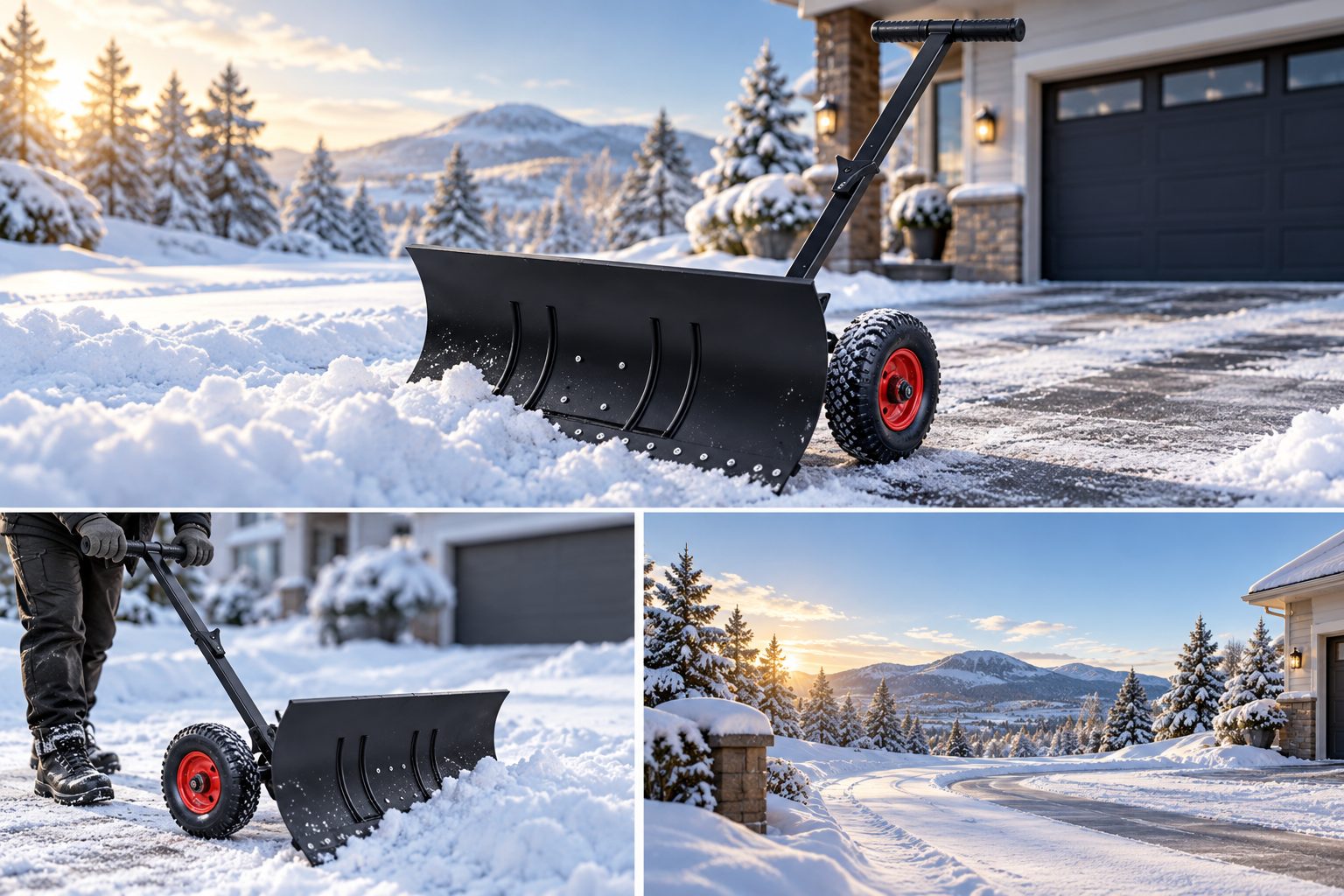
Why Blade Thickness Is Only Part of the Story
The illustrated snow shovel features a steel blade with a stated thickness of 1.5 mm and listed dimensions of 740 × 430 mm.
A wider blade may cover a larger clearing area per pass, but it also encounters greater resistance when pushing heavy or compacted snow.
Blade thickness influences rigidity and deformation resistance, while blade curvature affects how snow moves across the surface.
ENGINEERING FACTORS
Steel grade and mechanical properties
Blade thickness and dimensional accuracy
Curvature and forming consistency
Reinforcing components
Scraping-edge construction
Surface protection
THE MANUFACTURING INSIGHT
The best blade design balances effective snow movement, structural rigidity, product weight, and manufacturing efficiency.
02 / PNEUMATIC WHEELS
Why Two 10-Inch Wheels Can Change the User Experience
Unlike conventional hand shovels, wheeled snow pushers support part of their structure through a wheel assembly.
The illustrated model uses two 10-inch pneumatic wheels.
Pneumatic tires may help maintain traction and absorb some surface irregularities, depending on tire construction, inflation pressure, and ground conditions.
However, wheel size alone does not establish better performance.
Axle alignment, wheel bearings, mounting strength, and tire quality also matter.
THE ENGINEERING INSIGHT
A good wheel system should support controlled movement without introducing unnecessary instability or maintenance complexity.
03 / ADJUSTABLE BLADE ANGLE
Why One Blade Position May Not Suit Every Driveway
One of the most interesting features of this design is its stated 7-position blade adjustment.
An adjustable blade can provide more flexibility than a fixed straight-ahead configuration.
Depending on its adjustment geometry, it may allow the operator to direct snow toward one side while moving forward.
This can be useful when clearing longer driveways or paths where snow needs to accumulate along an edge.
Yet adjustable mechanisms introduce additional manufacturing considerations.
WHAT OEM BUYERS SHOULD EXAMINE
Locking mechanism reliability
Adjustment range and positioning accuracy
Structural strength at each setting
Connection wear under repeated use
Ease of adjustment with winter gloves
THE DESIGN PRINCIPLE
Adjustability creates value only when the mechanism remains secure, durable, and convenient to operate.
04 / HANDLE ERGONOMICS
Five Height Settings: More Than a Convenience Feature
The illustrated product lists a 1,000 mm handle size and a 5-position handle height adjustment.
Operator height, pushing posture, grip design, and force direction all influence usability.
An adjustable handle may accommodate different operator preferences, but the entire frame must remain structurally stable through the available settings.
Poorly designed joints can create movement or reduce confidence during operation.
THE ENGINEERING INSIGHT
Ergonomics and structural performance must be developed together, not treated as separate features.
05 / FRAME AND CONNECTION DESIGN
Where Structural Reliability Really Begins
The handle, blade, and wheel assembly work as a connected mechanical system.
When the blade encounters resistance from wet snow or an uneven surface, forces travel through the supporting frame and adjustment mechanisms.
Critical areas may include:
Blade-to-frame connections
Wheel axle mounting points
Handle adjustment joints
Welding locations
Bolted connections and locking components
A visually strong frame is not sufficient proof of reliable performance.
MANUFACTURING PERSPECTIVE
Connection quality can be just as important as the thickness of the steel components.
06 / CORROSION PROTECTION
Snow Equipment Must Be Designed for More Than Cold Weather
Snow removal equipment is exposed to moisture, repeated temperature changes, and potentially deicing salts.
Protective finishing should therefore be evaluated carefully.
Important considerations include surface preparation, coating adhesion, coverage around edges and welds, and suitable corrosion-resistance testing.
A black coating may provide a professional appearance, but its color alone does not establish durability.
THE QUALITY INSIGHT
Long-term product reliability depends on the complete finishing process, not simply the appearance of the final coating.
07 / REAL-WORLD PERFORMANCE
Where Does an Adjustable Wheeled Snow Shovel Deliver Value?
Not every winter environment creates the same operating demands.
Working Condition | Engineering Consideration |
|---|---|
Long, open driveway | Blade width and directional adjustment |
Light snow accumulation | Ease of movement and maneuverability |
Wet or heavy snow | Pushing resistance and frame strength |
Uneven pavement | Wheel traction and blade clearance |
Narrow pathways | Blade size and turning space |
Frequent operation | Connection durability and ergonomics |
IMPORTANT: A wheeled snow shovel may reduce the need for repeated lifting during some snow-clearing tasks, but deep, wet, compacted, or icy snow can still create substantial resistance.
Performance should be evaluated under representative operating conditions.
THE OEM MANUFACTURING EQUATION
What Makes Two Similar Snow Shovels Cost Differently?
Two products with comparable blade dimensions may involve very different manufacturing costs.
The difference can come from steel specifications, blade forming, wheel quality, adjustment mechanisms, assembly complexity, surface treatment, and inspection requirements.
For B2B buyers, value engineering is essential.
Material Efficiency
Use appropriate materials and reinforcement where structural performance requires them.
Manufacturing Consistency
Control forming dimensions, alignment, and assembly tolerances.
Component Selection
Evaluate purchased wheels, locking components, and fasteners for the intended application.
Packaging Optimization
Consider transport protection, assembly requirements, and carton dimensions.
The objective is not simply to reduce factory price. It is to create a reliable product with an efficient manufacturing process.
THE OEM BUYER CHECKLIST
What Should Importers Confirm Before Mass Production?
Before approving a heavy-duty wheeled snow shovel, international buyers should clarify:
Blade dimensions, steel grade, and thickness tolerances.
Maximum adjustment angles and locking mechanism details.
Wheel specifications, tire pressure, and axle construction.
Handle adjustment range and overall product dimensions.
Structural load and durability testing requirements.
Surface finishing and corrosion protection.
Assembly instructions, packaging, and labeling requirements.
These details help establish accurate quotations, reduce specification uncertainty, and support consistent mass production.
THE FINAL PERSPECTIVE
The Best Snow Shovel Is an Engineered System, Not Just a Strong Blade.
A heavy-duty wheeled snow shovel integrates material selection, blade geometry, wheel performance, adjustable mechanisms, and user ergonomics.
Each element contributes to the overall product experience.
For OEM/ODM buyers, a well-designed snow pusher should balance reliable performance, manufacturing efficiency, practical usability, and the needs of its intended market.
Better Engineering. Better Manufacturing Consistency. Better Product Value.
TWS INDUSTRIES
OEM/ODM Manufacturing for Winter & Outdoor Equipment
TWS Industries provides metal fabrication and OEM/ODM manufacturing solutions for international B2B customers.
Our relevant capabilities include sheet metal processing, forming, tube bending, welding, surface finishing, assembly, and export packaging.
For winter equipment development, we support discussions involving product specifications, material selection, manufacturing feasibility, customization, and production requirements.
Engineered for Practical Applications. Developed for Global Markets.
TWS Industries | Vietnam Metal Products Manufacturing
Related / Bài viết & sản phẩm liên quan
Explore more content and products hand-picked for this article.
 Blog
Wheeled Snow Pusher vs Traditional Snow Shovel: Which Is More Efficient?
Read more → Blog
What Makes a Well-Designed Outdoor Fire Pit? 6 Engineering Details
Read more → Blog
What Makes a Well-Designed Small Metal Raised Garden Bed? 6 Details That Matter
Read more → Blog
Why Choose a Wheeled Snow Pusher for Wide Areas?
Read more → Blog
Heavy-Duty Rolling Compost and Peat Moss Spreader
Read more → Product
Snow Pusher U Shape Handle Large Size No Steel Scraper
View product → Product
Snow Pusher U Handle W30" x H17" Blade NO Steel scraper
View product → Product
Snow Pusher T Handle with Wheels L740xW350mm
View product → Product
Heavy Duty Adjustable Snow Pusher with Wheels 30 Inch Steel Blade Snow Shovel for Driveway & Walkway
View product →